Artificial intelligence, machine learning, deep learning, and generative AI are related terms, but they do not mean the same thing. You may see them used interchangeably in product descriptions, which makes it harder to understand what a tool actually does. A useful starting point is to picture a set of overlapping approaches rather than four competing technologies.
Artificial intelligence (AI) is the broad field of building systems that produce useful predictions, recommendations, decisions, or content for a goal. Machine learning (ML) is a major way to build AI systems from data. Deep learning is a form of ML that uses multi-layer neural networks. Generative AI focuses on creating new content; many current generative systems use deep learning, but generation is a task, not a separate layer of the hierarchy.
The relationship at a glance
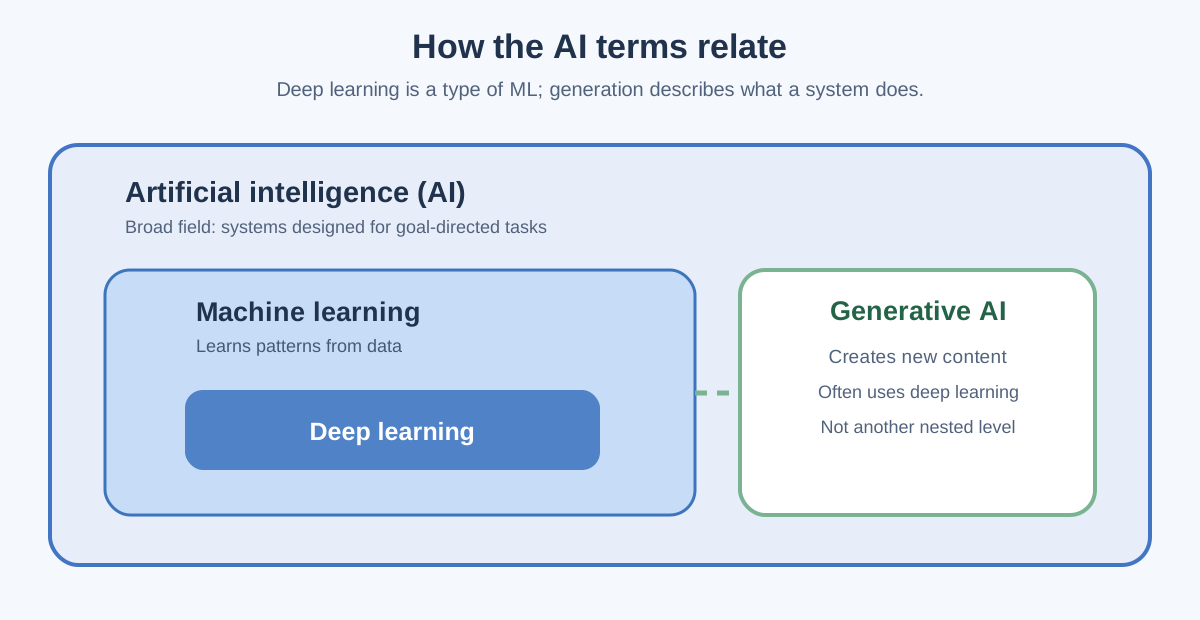
| Term | Main idea | Typical example |
|---|---|---|
| AI | Build a system that performs a goal-directed task | Route planning or a support assistant |
| Machine learning | Learn a pattern from examples rather than specify every rule | Predict whether a message is spam |
| Deep learning | Learn with a multi-layer neural network | Recognize objects in images |
| Generative AI | Create new text, images, audio, code, or other content | Draft an email from a prompt |
These examples describe common uses, not exclusive definitions. A spam filter can use a neural network or a simpler model. An image system can classify a picture or generate one. The question to ask is what the system is built to do and how it does it.
What does artificial intelligence include?
AI includes systems that reason with explicit rules or knowledge as well as systems that learn from data. Imagine a troubleshooting program that asks whether a printer is powered on and follows a carefully designed decision tree. Its rules come from people. Now imagine a photo service that learns to identify blurry pictures from labeled examples. Both can be discussed within AI, even though only the second uses ML.
Not every ordinary software feature is useful to call AI. A calculator follows a known arithmetic procedure, while an arrival-time estimator may combine historical trips and live conditions to make a prediction. The label matters less than understanding the method, expected accuracy, and failure modes.
What does machine learning add?
In machine learning, a developer supplies data and defines a task. A training process adjusts a model so its output better matches examples or another learning objective. After training, the model can make a prediction for a new input. For a spam filter, the input is a message; the output might be a spam probability. The filter does not need a separate hand-written rule for every phrase.
Example: Predicting late deliveries
Suppose a delivery team records route length, departure time, weather, and whether each order arrived late. A model can learn relationships in past orders and estimate the risk of lateness for a future order. To test whether it learned a useful pattern, the team evaluates it on orders that were not used for training. The model can still fail if routes, traffic, or recording practices change.
What makes deep learning different?
Deep learning uses neural networks with multiple processing layers. During training, the network adjusts many numerical parameters. This can help it learn complex patterns in images, speech, and language without a person defining every feature by hand. The word deep refers to the network structure, not to a guarantee of deeper understanding.
Deep learning often needs substantial data and computing resources, although the amount depends on the task and whether an existing model is reused. It is not automatically the best choice. For a small, well-structured table of business data, a simpler model may be easier to train, explain, and maintain.
Where does generative AI fit?
Generative AI produces new material in response to an input. A text model may continue or transform a prompt; an image model may create a picture from a description. Large language models are one important type of generative model, but generative AI also includes image, audio, and video systems.
Generation and prediction are connected: a text model can generate an answer by predicting a sequence of tokens. Still, a fluent answer is not the same as a checked fact. It can invent a citation, omit context, or follow a misleading prompt. When accuracy matters, you must verify the result against a reliable source or a real test.
Tip: Use “generative AI” when the important behavior is creating content. Use “machine learning” when the important behavior is learning from data. Use “deep learning” when the model architecture matters.
How do you choose the right approach?
- Describe the job: Do you need a category, a number, a recommendation, or a new draft?
- Check available data: Are there trustworthy examples, labels, and permission to use them?
- Set a quality measure: Decide what a useful result looks like and how you will test it.
- Start with a baseline: A clear rule or simple model may solve the problem before a large model is needed.
- Plan for review: Decide who checks high-impact outputs and how errors are reported.
For instance, an FAQ with stable answers may work well with a curated search page. A forecast based on historical measurements may benefit from ML. A tool that helps an editor draft many versions of a headline might use generative AI, with the editor deciding what to publish.
Conclusion
AI is the broad field; ML learns patterns from data; deep learning is an ML approach based on multi-layer neural networks; and generative AI creates new content, often using deep learning. These terms help when they clarify a system’s purpose and method. Start with the task, compare a simple baseline, and evaluate real outputs before choosing the most complex option.