Artificial intelligence (AI) helps software produce useful outputs—such as predictions, recommendations, decisions, or new content—from information it receives. You probably use it when a map estimates travel time, an email service flags spam, or a writing tool suggests a sentence. These systems do different jobs, so learning AI starts with understanding what goes into a system, what comes out, and how you check whether the result is reliable.
This tutorial gives you a practical map of the field. You do not need programming or advanced mathematics to begin. Later lessons will explain data, models, machine learning, generative AI, and responsible use in more detail.
What is an AI system?
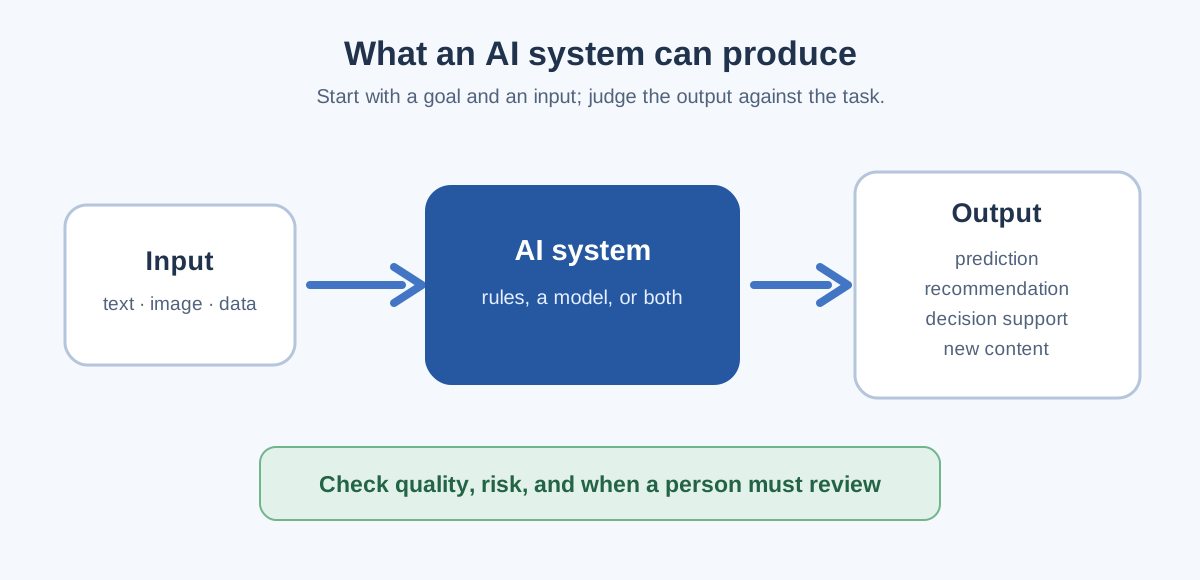
An AI system takes an input, processes it for a goal, and produces an output. The input could be a photo, a question, a transaction, or sensor readings. The output might be an object label, an answer, a fraud warning, or a route suggestion. A person or another program decides what to do with that output.
Example: A delivery-time estimate
A delivery app receives the destination, current traffic, and past trip times. It estimates an arrival time. If a road closes, the app may update its estimate. The useful question is not whether the app seems clever; it is whether its estimate helps people plan accurately under changing conditions.
AI is an umbrella term, not one algorithm. Some systems use human-written rules or structured knowledge. Many modern systems use machine learning: they find patterns in example data and apply those patterns to new inputs. A model is the part of such a system that carries the learned pattern.
Where does AI appear in everyday life?
| Task | Typical input | Useful output |
|---|---|---|
| Spam filtering | Email message | Spam or inbox suggestion |
| Translation | Text or speech | Text in another language |
| Product recommendations | Browsing and item information | Items likely to be relevant |
| Image description | Image pixels | Text describing visible content |
| Writing assistance | Prompt and surrounding text | A draft to review and edit |
These outputs are not equally dependable. A slightly imperfect music recommendation is inconvenient; a wrong medical or financial suggestion can cause harm. Always judge an AI system against its specific task and stakes.
How is AI different from ordinary automation?
Traditional automation follows instructions that a developer specifies, such as “send an email after a form is submitted.” An AI system often infers an output from data or a model. For example, a fixed rule might flag every email containing a particular phrase. A trained spam filter can consider many signals together and adapt its predictions when the pattern of spam changes.
The boundary is not always sharp. A real product may combine fixed rules, search, statistics, and learned models. You do not need to label every feature “AI” or “not AI.” Instead, ask: What information does it use, how does it produce the result, and how is that result checked?
The five ideas you will meet next
- Data: Examples or observations that a system uses for training, testing, or making a prediction.
- Model: A learned or designed representation used to turn inputs into outputs.
- Training: Adjusting a model using data so it performs a task better.
- Inference: Using a model to produce an output for a new input.
- Evaluation: Measuring performance on appropriate examples, including cases the model has not seen during training.
These ideas connect, but not every AI system needs the same workflow. A rule-based system can work without training data. A generative model may produce an answer, image, or code rather than a category or number. Learn the general pattern first; then study each approach on its own terms.
What AI can and cannot promise
AI can help sort large collections, find patterns, summarize material, and offer a useful first draft. It can also make confident mistakes, reflect problems in its data, miss unusual cases, or behave differently after its inputs change. Fluent text is not evidence that a statement is true. A high score on one test is not proof that a system is safe everywhere.
Example: Check a generated answer
Suppose an AI assistant explains a tax rule. Treat its response as a starting point, not an authority. Confirm the rule against the current official guidance before acting. For lower-stakes work, such as brainstorming section headings, you can review and edit the suggestions yourself.
Tip: State the task before choosing an AI tool. “Classify support requests,” “predict demand,” and “draft a reply” require different data, checks, and levels of human review.
A simple learning path
- Learn what AI systems do and how they differ from ordinary software.
- Understand data, models, training, inference, and evaluation.
- Compare AI, machine learning, deep learning, and generative AI.
- Explore a small worked example before using a large framework or API.
- Practice checking outputs, protecting data, and recognizing limitations.
You can follow this sequence even if your goal is to use AI rather than build models. It gives you enough vocabulary to ask better questions about a product’s behavior and claims.
Conclusion
AI is best understood through a task: an input goes into a system, and a prediction, recommendation, decision, or piece of content comes out. Machine learning is one important way to build such systems, but it is not the entire field. Start with the goal and the quality of the output, then learn how the system was trained and evaluated. That foundation will make later AI topics much easier to understand.