Responsible AI means designing and using AI systems with clear goals, appropriate checks, and accountability for their effects. A model can produce an impressive answer and still be wrong, unfair, or unsuitable for a particular decision. The safest habit is to judge an AI feature by the real task it performs and the people affected by its mistakes.
This lesson gives you a practical starting framework. It applies whether you are using a writing assistant, building a classifier, or evaluating a product that someone else built. Specific legal and organizational requirements vary, so treat this as an educational guide rather than a substitute for current policy or professional advice.
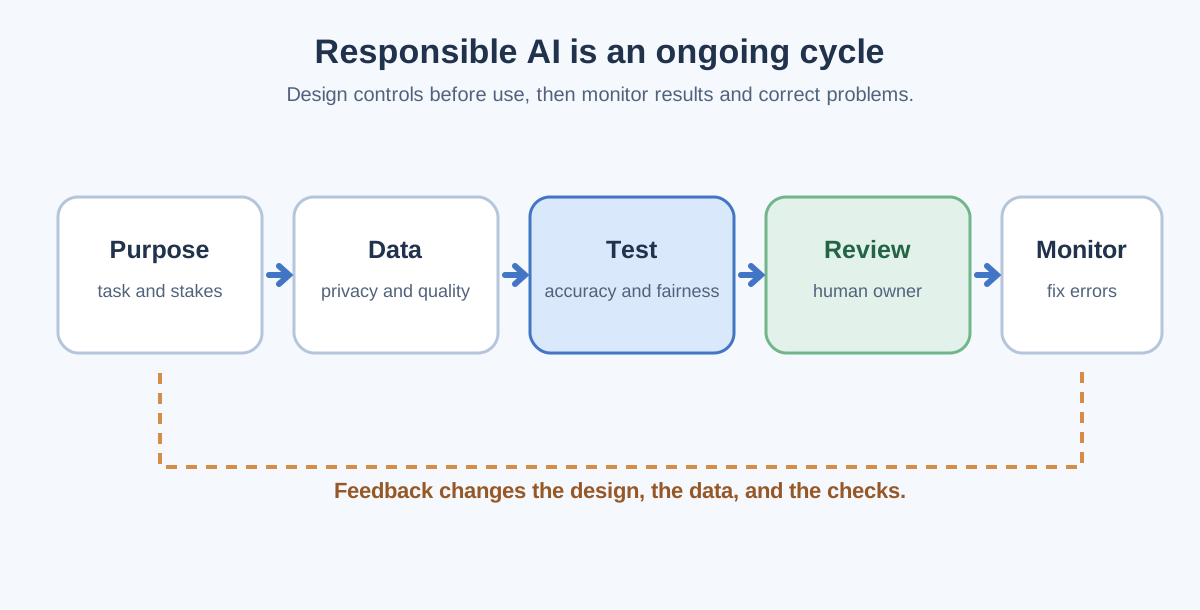
Start with the use case and the stakes
Write down what the system may do, what it must not do, and who can review its results. A music recommendation and a decision about access to a service have very different consequences. The more serious the possible harm, the stronger the need for suitable evidence, oversight, and a way to correct errors.
Example: Two uses of the same assistant
A team may let an assistant suggest titles for a public tutorial, with an editor choosing the final wording. The same team should not let it approve customer refunds based only on a generated answer. The second use affects money and trust; it needs a verified policy, a clear decision rule, an audit trail, and a person who can handle exceptions.
Check accuracy beyond a polished response
Generative AI can state a false claim confidently or invent a source. A predictive model can assign the wrong label even when its average test score looks good. Decide in advance which errors matter most. For a support router, track urgent requests sent to the wrong queue. For a document assistant, check whether each important statement is supported by the supplied document.
- Define a measurable outcome for the actual task.
- Test on examples not used to develop or tune the system.
- Include unusual, ambiguous, and difficult cases.
- Review error types and their consequences, not only one overall score.
- Repeat checks when the model, data, or surrounding workflow changes.
For high-stakes claims, a reliable external source or qualified reviewer remains the authority. An AI answer can help find what to investigate, but it cannot validate itself.
Look for bias and uneven performance
A model learns from available data, and those data may not represent everyone fairly. For example, a speech tool trained mostly on one accent may make more mistakes for other speakers. A hiring tool may repeat patterns from past decisions even if the past process was unfair. An average score can hide these differences.
When appropriate and permitted, evaluate performance across relevant groups and conditions. Check whether the same error has a greater impact on some people. Avoid assuming that removing a sensitive field automatically removes bias: other fields may still act as proxies. If you cannot gather enough evidence for a fair and safe use, narrow the use case or keep the decision with people.
Protect personal and confidential information
Before sending information to an AI service, ask whether the data are needed for the task and whether you are allowed to share them. Names, contact details, private messages, credentials, and unpublished business material may require special handling. Use an approved tool and follow its actual retention, access, and training settings; these settings can differ by product and change over time.
Minimize what you send. A question about the tone of a reply rarely needs a customer's full account history. Remove identifiers when practical, restrict access, and avoid placing passwords or secret keys in a prompt. If the task requires sensitive data, involve the people responsible for privacy and security before proceeding.
Keep human review meaningful
"A human is in the loop" is useful only if that person has time, authority, and information to catch mistakes. Give reviewers the original input, the AI suggestion, the evidence behind important claims, and a clear way to reject or correct the result. Decide which low-risk outputs may be used automatically and which must wait for approval.
| Situation | Practical control |
|---|---|
| Uncertain output | Ask for review or use a safe fallback |
| Unsupported factual claim | Check against a current authoritative source |
| Sensitive personal data | Minimize, restrict, or avoid sending it |
| High-impact decision | Require a qualified person and a way to appeal |
| Performance changes over time | Monitor outcomes and repeat evaluation |
Watch for misuse and changing behavior
An AI system may encounter misleading instructions inside a document or web page it reads. Do not let untrusted content silently override your task rules or trigger actions with sensitive permissions. Separate source material from instructions, limit what tools the system can use, and review actions that affect people or data.
After release, monitor complaints, errors, and changes in the inputs people provide. New content, changed policies, or a model update can alter performance. Make it easy for users to report a problem, and be ready to pause or revise the feature if the evidence shows harm.
Tip: For every AI feature, write down five items: purpose, data allowed, quality test, human owner, and fallback. If you cannot name them, the feature needs more design work.
Conclusion
Responsible AI is an ongoing practice, not a label you add after development. Start with the task and its risks, test real outcomes, look for uneven performance, protect data, and give people a meaningful way to review and correct errors. These habits help you use AI's benefits while staying honest about what the system can and cannot guarantee.