An AI system is easier to understand when you follow a single request from start to finish. It receives an input, uses rules or a model to process that input, and returns an output for a defined goal. The output might be a category, a number, a recommendation, or a draft. What happens between input and output depends on the approach the system uses.
This lesson follows the workflow behind many modern AI products, while making an important distinction: not every AI system is trained from data. A hand-built rule system and a learned model can solve similar problems in very different ways.
Start with the task
Before choosing a model, describe the job in plain language. “Help the support team” is vague. “Route each incoming message to billing, delivery, or technical support” tells you what the input and output must be. It also makes evaluation possible: you can compare the system’s route with a route chosen by an experienced reviewer.
Example: Route a support message
| Part | In this example |
|---|---|
| Goal | Send a message to the right team |
| Input | “My payment went through twice” |
| Output | Billing |
| Check | Compare the route with a reviewed answer |
| Fallback | Send uncertain or sensitive cases to a person |
Defining the fallback matters. A system does not become useful merely because it can produce an answer; it must also know when the answer is uncertain or the consequences of a mistake are high.
Two ways to turn an input into an output
Use explicit rules
A developer can write a rule such as “if a message contains an order number and the word refund, route it to billing.” This is easy to inspect, but it may miss different wording or fail when one message mentions several issues. Rules work best when the cases are clear and stable.
Use a learned model
A machine-learning model can be trained on examples that people have already labeled. Instead of checking one fixed phrase, it can learn patterns across many messages. When a new message arrives, the model may assign scores to the possible teams. A product might route a high-confidence case automatically and send a low-confidence case for review.
Both approaches may be combined. For example, a learned model can suggest the team while a fixed rule prevents an account-closure request from being handled automatically.
Where do data and training fit?
For a learned model, data supplies examples of the task. Each support example might include a message and its correct team. The training process adjusts the model so its predictions align better with those examples. Before training, people must decide which data is relevant, whether labels are accurate, and whether private information may be used.
Training is not the same as looking up a saved answer. A model learns numerical patterns from examples; it does not reliably store a perfect copy of every fact. A system can also use retrieval—finding relevant documents at request time—to give the model current context. Retrieval may improve an answer, but it does not guarantee accuracy if the documents are wrong or the model misreads them.
What happens during inference?
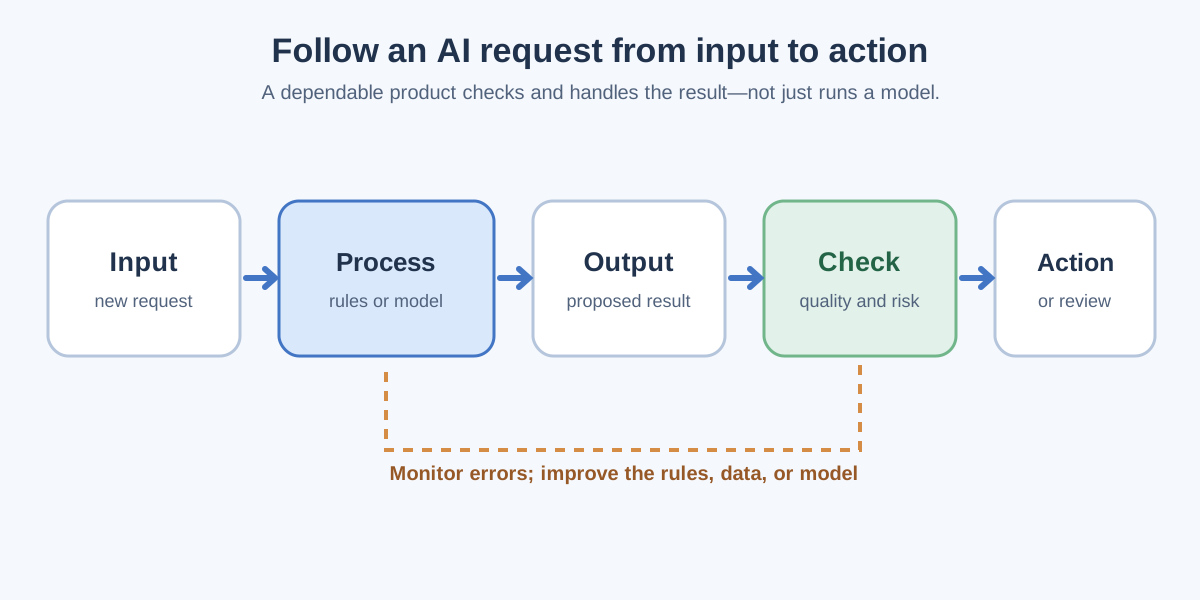
Inference is the stage when the finished system handles a new input. For the support router, the application receives the message, prepares it in the expected format, runs the rule or model, and returns a proposed team. It may then apply confidence thresholds, safety rules, and human review before making a final decision.
- Receive a new request.
- Check that the input is usable and remove information that is not needed.
- Run the rule or model to produce an output.
- Apply product rules and review uncertain cases.
- Record the result needed for monitoring, with appropriate privacy controls.
A generative assistant follows a related request-time flow, but its output is new content rather than a class label. It may use a prompt, conversation context, retrieved documents, and safety checks. The same principle holds: you should evaluate the final output in its real use, not only the underlying model.
How do you know whether it works?
Test the system on examples that were not used to train or tune it. For routing, you can count correct and incorrect team assignments, but a single accuracy number may hide important errors. Sending a billing message to delivery may be inconvenient; sending an urgent security report to a general queue may be serious. Review error types, not just averages.
After deployment, check whether real messages have changed. New products, new languages, seasonal demand, or changes in customer wording can reduce performance. Monitoring, feedback, and periodic re-evaluation are part of the system, not an optional finishing touch.
Tip: Draw an AI feature as five boxes—input, processing, output, check, and fallback. If one box is unclear, the feature is not yet ready to rely on.
Conclusion
AI works by turning information into an output for a specific goal, using explicit rules, a learned model, or both. Training builds a learned model; inference uses the finished system on a new input. A dependable product also checks quality, handles uncertainty, protects data, and keeps monitoring results after release. Follow that full path whenever you assess an AI claim.